
It is easy for candidates to Make A1 today in Agricultural Science with the ultimate guide on NECO Agric Science Questions and answers with PDF Download for Objectives/Essay here. The National Examination Council (NECO) Agric Science Objectives and Theory Solution guide is here for you (Paper 1&2). Get free Likely Agric Science Expo/Runs below.

Correct Agric Science NECO Questions and answers and how to answer the agriculture exams Questions (OBJ & Essay) without stress are provided here. This article also made provision for NECO Agric Science Past Questions and answers for practice for interested.
The National Examination Council, NECO Agric Science exams questions papers and other related materials are adequately provided for candidates on Time. Read more on the NECO Agric Science objectives and Theory exams details below.
Updates on NECO Agricultural Science Objectives and Essay Papers (1&2)
The National Examination Council, NECO Agric Science exam booklet will consist of two (2) Sections (paper I and II). Do not open the booklet until you are told to do so. While waiting, write your Name and Examination Number in the spaces provided at the top right-hand corner of this booklet.
Answer Paper I on your objective test answer sheet. Paper II is expected to last for1 hour. On completion of Paper I, the objective test answer sheet will be collected. Candidates will answer Paper II on their answer booklet.
Agric Science Answers to Objectives Questions
The Likely NECO SSCE Agric Science Objectives Exams Questions and answers are not yet updated. We are working hard to ensure that the latest updates on NECO Agric Science exams are provided here.
1. Assuming a sow was serviced on May 1 and conceived the same day, the expected date of parturition is
- A. October 2
- B. September 30
- C. August 24
- D. June 2
Correct Answer: B (September 30)
2. Which of the following crops require a nursery?
- A. Rubber
- B. Soya bean
- C. Yam
- D. Cotton seed
Correct Answer: A (Rubber)
3. If the seed rate for the cultivation of cowpea is 25 kg per hectare, determine the quantity of cowpea seeds required to cultivate a farmland measuring 100 m by 500 m.
- A. 125 kg
- B. 50 kg
- C. 250 kg
- D. 1,250 kg
Correct Answer: A (125 kg)
4. Maceration is carried out in the processing of
- A. cocoa
- B. oil palm
- C. cotton
- D. paddy rice
Correct Answer: B (oil palm)
5. Which of the following statements about underground drainage is true
- A. Furrows are constructed to direct water out of the farmland
- B. Ditches are dug from a source of water to the farmland
- C. Ditches are constructed to remove excess water
- D. Water seeps into tiles to reach an outlet where it is discharged
Correct Answer: D (Water seeps into tiles to reach an outlet where it is discharged)
6.Soil structure is described as the
- A. proportion of different sizes of soil particles
- B. degree of water percolation within the soil
- C. degree of soil aeration within the soil
- D. arrangement of soil particles into aggregates
Answer: D (arrangement of soil particles into aggregates)
7.A beneficial effect of bush burning is that it
- A. replenishes oxygen in the atmosphere
- B. increases the organic matter of soil
- C. encourages the regeneration of grasses
- D. increases the population of soil microorganisms
Answer: C (encourages the regeneration of grasses)
8.If the seed rate for the cultivation of cowpea is 25 kg per hectare, determine the quantity of cowpea seeds required to cultivate a farmland measuring 100 m by 500 m.
- A. 125 kg
- B. 50 kg
- C. 250 kg
- D. 1,250 kg
Answer: A (125 kg)
9.Maceration is carried out in the processing of
- A. paddy rice
- B. oil palm
- C. cotton
- D. cocoa
Answer: B (oil palm)
10. Which of the following pairs of livestock diseases could be contracted through inhalation?
- A. Coccidiosis and rinderpest
- B. Newcastle disease and aspergillosis
- C. Anthrax and tuberculosis
- D. Gumboro and brucellosis
Answer: B (Newcastle disease and aspergillosis)
11.Which of the following statements about underground drainage is true
- A. Ditches are constructed to remove excess water
- B. Ditches are dug from a source of water to the farmland
- C. Furrows are constructed to direct water out of the farmland
- D. Water seeps into tiles to reach an outlet where it is discharged
Answer: D (Water seeps into tiles to reach an outlet where it is discharged)
12.Grading of farm produce is important because it
- A. maintains produce quality
- B. prolongs storability
- C. facilitates pricing
- D. facilitates transportation
Answer: C (facilitates pricing)
13. The part of a disc plough to which discs are connected is
- A. furrow wheel
- B. standard
- C. scraper
- D. beam
Answer: B (standard)
14.The number of teats in the udder of a cow is
- A. four
- B. two
- C. six
- D. eight
Answer: A (four)
15.Which of the following paring enterprise could best be combined with fish farming for mutual benefits?
I. Vegetable production
II. Beekeeping
III. Poultry production
- A. I and III only
- B. I, II and III
- C. I and II only
- D. II and III only
Answer: A (I and III only)
16.Steaming up ration should be fed to
- A. pregnant animals
- B. weaned young animals
- C. breeding female animals
- D. lactating animals
Answer: A (pregnant animals)
17.Monocotyledonous crops are characterized by
- A. parallel-veined leaves
- B. woody stems and branches
- C. taproot system
- D. net-veined leaves
Answer: A (parallel-veined leaves)
18.The storage structure usually installed by the government for bulk storage of grains in West Africa is
- A. crib
- B. rhombus
- C. bin
- D. silo
Answer: D (silo)
19.In order to backup extension messages, an extension agent should
- A. provide marketing channels for farmers
- B. assist farmers in locating sources of farm inputs
- C. procure agricultural loans for farmers
- D. provide modern machines to farmers
Answer: B (assist farmers in locating sources of farm inputs)
19.Post-planting operations in cocoa plantation include
I. rogueing
II. stumping
III. mulching
- A. I and II only
- B. I, II and III
- C. I and III only.
- D. II and III only
Answer: B (I, II and III)
20.A major reason for encouraging afforestation in arid regions of West Africa is to
- A. serve as forest reserve for wildlife conservation
- B. serve as windbreak to check desert encroachment
- C. increase timber production for export
- D. provide shade for crops sin taungya farming
Answer: B (serve as windbreak to check desert encroachment)
21.The farming system generally recommended for farm settlement scheme is
- A. pastoral farming
- B. mixed cropping
- C. continuous cropping
- D. mixed farming
Answer: D (mixed farming)
22.Which of the following products is not a primary forest product?
- A. Plup
- B. Fuelwood
- C. Timber
- D. Mushroom
Answer: A (Plup)
23.A pest of honeybee is
- A. bird
- B. grasshopper
- C. lizard
- D. tick
Answer: B (grasshopper)
24.Cotton stainer is an insect pest of
- A. cotton
- B. pepper
- C. okro
- D. onion
Answer: A (cotton)
25.The reduction of three seedlings of maize to two plants per stand is referred to as
- A. rogueing
- B. thinning
- C. weeding
- D. pruning
Answer: B (thinning)
26.Which of the following tools are used in soil analysis?
I. pH meter
II. Sieve
III. Hygrometer
- A. I and II
- A. I and III
- C. I, II and III
- D. II and II
Answer: C (I, II and III)
27.Examples of cover crops are
- A. Centrosema pubescens and Mucuna utilis
- B. Moringa oleifera and Imperata cylindrica
- C. Panicum maximum and Pennisetum purpureum
- D. Calopogonium mucunoides and Gliricidia sepium
Answer: A (Centrosema pubescens and Mucuna utilis)
28.High relative humidity in a brooder house could lead to
- A. reduced feed intake
- B. production of dry litter
- C. build up of pests and diseases
- D. heat stress
Answer: C (build up of pests and diseases)
29.Study the table below and use it to answer the question
| Cost Price (N) | Useful life (Years) | Salvage value (N) | Annual depreciation (N) | Total depreciation |
| 20000 | Y | 5000 | 1000 annum | 15000 |
| 60000 | 10 | 18000 | 4200 annum | Z |
The total depreciation represented by Z in the illustrated table is
- A. N 42,000
- B. N78,000
- C. N 22,200
- D. N 55,800
Answer: A (N 42,000)
30.Study the table below and use it to answer the question
| Cost Price (N) | Useful Life (Life) | Salvage value (N) | Annual depreciation (N) | Total depreciation |
| 20000 | Y | 5000 | 1000 annum | 15000 |
| 60000 | 10 | 18000 | 4200 annum | Z |
The useful life represented by Y in the illustrated table is
- A. 3 years
- B. 4 years
- C. 15 years
- D. 20 years
Answer: C (15 years)
31.The bacterium which is responsible for conversion of ammonium compounds to nitrites in the nitrogen cycle is
- A. Nitrobacter
- A. Rhizobium
- B. Nitrosomonas
- C. Azotobacter
Answer: B (Nitrosomonas)
32.The risk of production in agricultural business is borne by the
- A. farm owner
- B. farm labour
- C. farm assistant
- D. farmer’s family
Answer: A ( farm owner)
33.A combine harvester is mainly used for harvesting
- A. tomato
- B. groundnut
- C. pepper
- D. rice
Answer: D (rice)
34.If 200 ml of water was poured on a soil sample in a beaker and 25% of the water drained through the soil, determine the amount of water retained in the soil.
- A. 25 ml
- B. 175 ml
- C. 50 ml
- D. 150 ml
Answer: D (150 ml)
35.
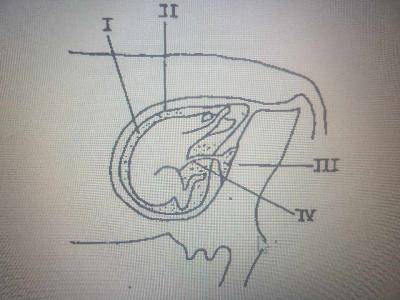
The diagram above illustrates a reproductive process in a farm animal. Study it and answer the question.
The reproductive process illustrated by the diagram is
- A. lactation
- B. gestation
- C. ovulation
- D. heat
Answer: B (gestation)
36.
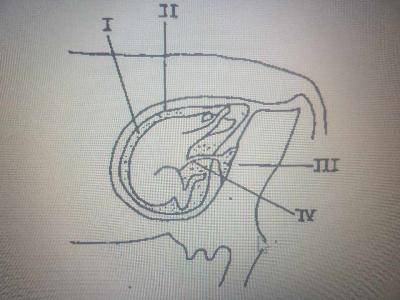
The diagram above illustrates a reproductive process in a farm animal. Study it and answer the question.
The parts which protect the foetus from mechanical injury are labelled
- A. I and III
- B. I and II
- C. III and IV
- D. II and III
Answer: B (I and II)
37.Seedlings are best transplanted in the field
- A. early in the morning and late in the evening
- B. at midday and at dusk
- C. early in the morning and at midday
- D. late in the morning and late in the evening
Answer: A (early in the morning and late in the evening)
38.What is a potential disadvantage of mass media for farmers?
- A. Lack of credibility in agricultural news
- B. Insufficient coverage of farming practices
- C. Limited access to information
- D. Increased cost of agricultural inputs
Answer: C (Limited access to information)
39.Which of the following is an example of a pasture commonly used in agriculture?
- A. Corn plantation
- B. Orange orchard
- C. Cattle pasture
- D. Wheat field
Answer: C (Cattle pasture)
40.Which of the following is NOT a component of soil?
- A. Organic matter
- B. Water
- C. rubber
- D. Minerals
Answer: C (rubber)
41.What is the primary purpose of processing facilities in agriculture?
- A. To process raw agricultural materials into value-added products
- B. To provide shelter and housing for livestock
- C. To package and label agricultural products
- D. To store and preserve harvested crops
Answer: A (To process raw agricultural materials into value-added products)
42.What are the primary benefits of agricultural extension services?
- A. Preservation of traditional farming practices
- B. Enhanced knowledge and skills of farmers
- C. Increased crop diversity and yield
- D. Improved market access for agricultural products
Answer: B (Enhanced knowledge and skills of farmers)
Agric Science NECO Theory Questions
The likely Essay Questions and answers for NECO Agric Science exams is not yet Available for candidates. We will equally provide some available updates on the Agric Science theory paper.
1 a. Explain each of the following terms:
i. agricultural ecology ii. ecosystem
(b.) Mention:
i. two biotic components of a farm ecosystem ii. three abiotic components of a farm ecosystem
(c). State five precautions that should be taken during storage of bags of maize in a store
(d). Give four examples of bedding plants
2. a. Differentiate between credit and subsidy in agricultural finance (b). Name five agricultural inputs that are subsidised by the government (c). Mention six periodic maintenance practices on a tractor
(d). State five precautions that should be taken when operating farm machinery
Agric Science Expo/Runs for SSCE Exams 2026
The National Examination Council, NECO exams is for candidates that are fully prepared. The likely NECO objectives and Theory Expo are to guide you on how to answer the NECO exams Questions.
The following hints are very useful while attempting questions in the exams hall:
- Pray before the commencement of the NECO Agric Science exams
- Avoid every disturbance before and during the exams
- Read the instructions provided on the questions paper accordingly
- Call the attention of the invigilators where there’s confusion
- Read the objectives questions at least three times before chosing your answer
- Start with the Questions you know best on the theory section.
- Make sure your handwriting are readable
- Cross-check your work before submitting them.
Thanks, that all concerning NECO Agric Science Questions and answers Objectives/Essay. Use the comments section below for your Questions.
Related Post
- NECO Literature in English Questions and Answers
- NECO Government Questions and Answers
- NECO Physics Questions and Answers
- NECO Civic Education Questions and Answers
- NECO Chemistry Questions and Answers
- NECO Biology Questions and Answers
- NECO English Language Questions and Answers
- NECO Economics Questions and Answers
- NECO Mathematics Questions and Answers
- NECO Marketing Questions and Answers
- NECO Timetable
- NECO Registration Form
- How to Check NECO Result
