
WAEC Physics free and correct Questions and Answers for candidates are now available online. People may wish to have access to WAEC expo/runs in Physics, but I tell you, the details here on Objectives and theory Physics WAEC Questions and Answers provided for you is super.

The West African Examination Council (WAEC) Physics paper 1 and 11 (Objectives and Essay) schedule is available in the official Timetable. All the necessary materials will be provided by the management board for the smooth running of the exams. To pass WAEC Physics with A1, keep reading fore latest news on correct Physics answers.
WASSCE Physics past Questions papers has been provided here to help you get ready for the questions that will be presented to you. Likely Physics expo questions and Answers and how to answer the questions without wasting time are equally provided.
Available Physics Answers to Objectives Questions
There are free WAEC Physics Past Questions and Answers for you. Take your time and make good use of it while waiting for the latest update on Likely WAEC Physics expo.
The following are Sample free Physics Objectives Past Questions and Answers:
1. Which part of the human eye performs the same function as the diaphragm in a lens camera?
- A. Choroid
- B. Retina
- C. Iris
- D. Cornea
Answer: C ( Iris)
2. Which of the following devices is associated with alternating currents only?
- A. Step-up transformer
- B. Lead-acid accumulator
- C. Moving coil galvanometer
- D. Induction coil
Answer: A (Step-up transformer)
3. The purpose of commutators in a direct current motor is to
- A. reverse the direction of the current after every half rotation
- B. increase the efficiency of the motor.
- C. enable a uniform couple to act on the coil.
- D. increase the number of rotations per second
Answer: A (reverse the direction of the current after every half rotation)
4. In the Rutherford scattering experiment, a beam of alpha particles was fired at a thin gold film and few of the particles were deflected considerably. This shows that the nucleus of an atom
- A. is positively charged and is concentrated in a tiny volume
- B. contains protons and electrons distributed in a tiny volume.
- C. is concentrated in a tiny volume and contains alpha particles.
- D. is distributed in a tiny volume and emits alpha particles.
Answer: A (is positively charged and is concentrated in a tiny volume)
5. When an electron jumps directly from an orbit of n = 4 to n = 2,
- A. a photon is absorbed
- B. a photon is emitted
- C. two photons are emitted.
- D. two photons are absorbed
Answer: B (a photon is emitted)
6. Two objects, A and B, accelerate from rest at uniform rates. B accelerates twice as much as Compared to A, B travels
- A. at the same distance as A.
- B. six times as far.
- C. two times as far.
- D. three times as far.
7. The constant temperature at which a liquid change into gaseous state is known as
- A. dew point
- B. boiling point
- C. melting point
- D. evaporation point
Answer: B (boiling point)
8. A convex mirror is used as a driving mirror; however, a disadvantage in this regard is that the image
- A. is not as bright as we would like
- B. it produces is real
- C. it produces is virtual
- D. appears farther away from the driver
Answer: D (appears farther away from the driver)
9.In storing magnets, the keeper is used to
- A. increase the strength of the magnet.
- B. reduce self demagnetization
- C. protect the magnet from stray electric field
- D. cancel the effect of the earth’s magnetism
Answer: B (reduce self demagnetization)
10. The maximum displacement of particles from equilibrium position in a wave motion is known as
- A. wave length.
- B. amplitude.
- C. frequency.
- D. polarization.
Answer: B (amplitude)
11. Atmospheric pressure decreases with an increase in altitude because:
- A. Internal energy increases with altitude
- B. Temperature increases with altitude.
- C. Acceleration due to gravity increases with altitude.
- D. Interaction among air molecules decreases due to less quantity of air.
Answer: D (Interaction among air molecules decreases due to less quantity of air.)
12. The phenomenon used for explaining the formation of a rainbow in the sky is
- A. reflection.
- B. refraction.
- C. interference.
- D. dispersion.
Answer: D (dispersion.)
13. The correct sequence of ionization power of alpha particle, gamma ray, and beta particle respectively is
- A. medium, low, high.
- B. high, medium, low.
- C. low, medium, high.
- D. high, low, medium.
Answer: D (high, low, medium.)
14.
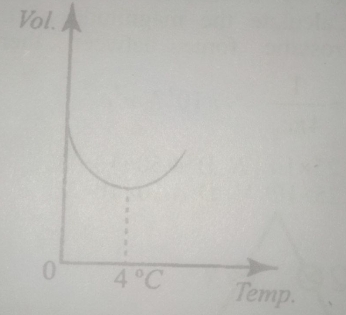
The diagram above illustrates the graph for
- A. the variation of the volume of a gas with increasing temperature
- B. expansion curve of mercury
- C. expansion curve of liquid oxygen
- D. anomalous expansion of water
Answer: D (anomalous expansion of water)
15.The constant temperature at which a liquid change into gaseous state is known as
- A. evaporation point
- B. boiling point
- C. melting point
- D. dew point
Answer: B (boiling point)
16.Water is readily available but it is not a thermometric liquid mainly because
- A. clings to glass
- B. does not expand uniformily
- C. boils at low temperature
- D. is colourless
Answer: B (does not expand uniformily)
17. The amount of heat energy that will be extracted when 0.02kg of water vapor condenses to water at 97ºC is [specific heat capacity of water = 4200Jkg−1k−1, Specific heat of vaporization of water = 2.26 x 10⁶Jkg−1]
- A. 45,452J
- B. 45,200J
- C. 25,200J
- D. 252J
Answer: A (45,452J)
18.A convex mirror is used as a driving mirror; however, a disadvantage in this regard is that the image
- A. it produces is virtual
- B. it produces is real
- C. is not as bright as we would like
- D. appears farther away from the driver
Answer: D (appears farther away from the driver)
19.Which of the following factors does not affect the speed of sound?
- A. Loudness.
- B. Wind direction
- C. Temperature
- D. Material density
Answer: A (Loudness.)
20.In storing magnets, the keeper is used to
- A. cancel the effect of the earth’s magnetism
- B. reduce self demagnetization
- C. protect the magnet from stray electric field
- D. increase the strength of the magnet.
Answer: B (reduce self demagnetization)
21.A galvanometer of full-scale deflection 10 mA has a resistance of 5Ω. Calculate the shunt needed to convert it to measure currents of 2 A.
- A. 0.025Ω
- B. 0.050Ω
- C. 0.250Ω
- D. 0.500Ω
Answer: A (0.025Ω)
22.A non-conducting vessel contains a liquid of mass 70 g at 25º C. Another 70.0g of the same liquid at 35ºC is quickly poured into the vessel. Determine the final temperature of the mixture
- A. 15ºC
- B. 20ºC
- C. 30ºC
- D. 40ºC
Answer: C (30ºC)
23.The maximum displacement of particles from equilibrium position in a wave motion is known as
- A. wave length.
- B. amplitude.
- C. frequency.
- D. polarization.
Answer: B (amplitude.)
24.Four pieces of constantan wire, marked E, F, G, and H, each of length 1.0m, are at the temperature. Their respective diameters are 1 mm, 2 mm, 6 mm, and 10 mm. Which wire has the highest resistance?
- A. E
- B. F
- C. G
- D. H
Answer: A (E)
25.Atmospheric pressure decreases with an increase in altitude because:
- A. Acceleration due to gravity increases with altitude.
- B. Temperature increases with altitude.
- C. Internal energy increases with altitude.
- D. Interaction among air molecules decreases due to less quantity of air.
Answer: D (Interaction among air molecules decreases due to less quantity of air.)
26.The main difference between X-rays and gamma rays is in their
- A. ionizing ability.
- B. absorbing rate.
- C. mode of propagation.
- D. mode of production.
Answer: D (mode of production.)
27.The phenomenon used for explaining the formation of a rainbow in the sky is
- A. interference.
- B. refraction.
- C. reflection.
- D. dispersion.
Answer: D (dispersion.)
28.Which of the following modes is the most economical method of transmitting electrical power over a long distance?
- A. Alternating current at high voltage and low current.
- B. Alternating current at low voltage and high current.
- C. Direct current at high voltage and low current.
- D. Direct current at low voltage and high current.
Answer: A (Alternating current at high voltage and low current.)
29.The correct sequence of ionization power of alpha particle, gamma ray, and beta particle respectively is
- A. low, medium, high.
- B. high, medium, low.
- C. medium, low, high.
- D. high, low, medium.
Answer: D (high, low, medium.)
30.Which of the following statements about a projectile is not correct?
- A. Projectile motion is a two-dimensional motion.
- B. A projectile is an object launched into the air and allowed to move freely due to gravity.
- C. The range of a projectile is independent of the acceleration due to gravity.
- D. The time of flight dependent of the acceleration due to gravity
Answer: C (The range of a projectile is independent of the acceleration due to gravity.)
31.The inside portion of a hollow metal sphere of diameter 20 cm is polished. The portion will therefore form a
- A. Concave mirror of focal length 5cm.
- B. Concave mirror of focal length 10 cm.
- C. Convex mirror of focal length 10 cm
- D. Convex mirror of focal length 5cm
Answer: D (Convex mirror of focal length 5cm)
32.In which of the following devices is the thermal expansion considered a disadvantage?
- A. Fire alarm
- B. Thermostat
- C. Bimetallic thermometer
- D. Balance wheel of a watch
Answer: D (Balance wheel of a watch)
33.A capacitor described as a mica capacitor has
- A. both plates are made of mica.
- B. a mica dielectric.
- C. a dielectric made of mica
- D. the same capacitance as that of mica
Answer: C (a dielectric made of mica)
34.Which of the following terms has different dimension from the others?
- A. Stress x Strain
- B. Pressure
- C. stress/strain
- D. Torque
Answer: D (Torque)
35.The depolarizing agent in a Leclanché cell is
- A. powdered carbon.
- B. manganese (IV) oxide.
- C. carbon rod.
- D. ammonium.
Answer: B (manganese (IV) oxide.)
36.A boy of mass 40 kg jumps off a stationary skateboard and moves horizontally with a speed of 1.5 m/s while the skateboard moves in the opposite direction with a speed of 20 m/s. Calculate the mass of the skateboard.
- A. 60 kg
- B. 40 kg
- C. 3 kg
- D. 2 kg
Answer: C (3 kg)
37.

The diagram above illustrates two boxes P and Q of masses 27.3 kg and 6.2 kg respectively on a smooth horizontal surface. If a force F of 150 N is applied to the combined forces, calculate the acceleration.
- A. 4.5 ms−2
- B. 33.5 ms−2
- C. 70 ms−2
- D. 150 ms−2
Answer: A (4.5 ms−2)
38.An object 2.0 cm high is placed at the radius of curvature of a concave mirror such that it is perpendicular to the principal axis of the mirror. Determine the height of the image.
- A. 0.5 cm
- B. 1.0 cm
- C. 1.5 cm
- D. 2.0 cm
Answer: D (2.0 cm)
39.Light of energy 1.12 x 10⁻¹⁸ J is incident on a metal of ejected electrons with maximum energy of 8.0 x 10⁻¹⁹J. Calculate the threshold frequency of the metal. [h = 6.626 x 10⁻³⁴Js]
- A. 4.8 x 10¹⁴Hz
- B. 1.2 x 10¹⁵Hz
- C. 1.7 x 10¹⁵Hz
- D. 2.8 x 10¹⁵Hz
Answer: A (4.8 x 10¹⁴Hz)
40.A body of mass, m is projected vertically upward with a velocity, y. At what position will the potential energy be maximum?
- A. y/g
- B. 2y2/g
- C. y2/2g
- D. y2/4g
Answer: C (y2/2g)
41.A 2 μF capacitor is connected directly across a 150 Vrms, 60 Hz A.C source. Calculate the r m s value of the current.
- A. 0.113 A
- B. 0.160 A
- C. 150 A
- D. 1324 A
Answer: A (0.113 A)
42.
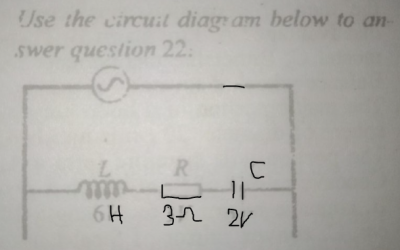
A constant voltage source supplies a sinusoidal alternating e.m.f. The voltage marked against the components are their peak values. Determine the peak value of the applied e.m.f
- A. 1V
- B. 4V
- C. 5V
- D. 2V
Answer: C ( 5V)
43.For a convex lens to form a real image, the distance between the object and the screen will be:
- A. equal to the focal length of the lens
- B. less than the focal length of the lens
- C. twice the focal length of the lens
- D. four times the focal length of the lens
Answer: C (twice the focal length of the lens)
44.A particle of mass 3.6 x 10⁻⁶kg revolving around the earth has a radial acceleration of 4.3 x 10⁷ms−2. Calculate the centripetal force of the particle.
- A. 1.55 x 10²N
- B. 2.00 x 10⁻²N
- C. 6.25 x 10⁻¹⁴N
- D. 1.00 x 10²N
Answer: A (1.55 x 10²N)
45.
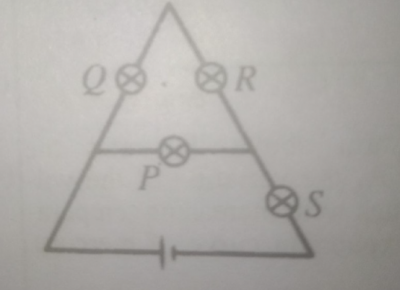
In the circuit diagram above, which lamp causes the other to go off?
- A. P
- B. Q
- C. R
- D. S
Answer: D (S)
46.All of the following uses are practical applications of x-ray except
- A. the treatment of tumors
- B. determining the depth of a mine
- C. dental operation
- D. detecting fractures in bones
Answer: B (determining the depth of a mine)
47.A temperature of 60º C is equivalent to
- A. 25ºF
- B. 140ºF
- C. 50ºF
- D. 108ºF
Answer: B (140ºF)
48.A cube of water with side 10.0 cm floats vertically in water with 4.5 cm its length submerged. Calculate the density of the wood.
[Density of water = 1 g/cm3; D = 0.090 g/cm3]
- A. 0.090 g/cm3
- B. 0.450 g/cm3
- C. 0.230 g/cm3
- D. 0.0450 g/cm3
Answer: B (0.450 g/cm3
48.Chromatic aberration in lenses can be corrected by using a combination of
- A. diverging and converging lenses.
- B. an opaque material to cover the rims of lenses.
- C. wide parallel beams on the lenses’ surface.
- D. a thin convex lens.
Answer: A (diverging and converging lenses.)
49.An object is placed 1.5 m from a plane mirror. How far is the image from the object?
- A. 3.0 m
- B. 1.3 m
- C. 1.0 m
- D. 0.3 m
Answer: A (3.0 m)
50.To convert a milli-ammeter to an ammeter, a resistor of low value is necessary to connect a resistor of
- A. low value in series with it
- B. high value in series with it
- C. low value in parallel with it
- D. high value in parallel with it
Answer: C (low value in parallel with it)
51.A stone of mass 200 g attached to a string is made to revolve in a horizontal circle of radius 1.5 m at a steady speed of 5 m/s. Calculate the tension in the string at the bottom of the circle.
- A. 5.3 N
- B. 3.3 N
- C. 2.0 N
- D. 1.3 N
Answer: A (5.3 N)
52.The law of conservation of momentum is stated for closed and isolated system. What are the two conditions for a system to be closed and isolated?
- A. No external force acts on the system and there is no change in mass of the system.
- B. No external force acts on the system and there is a gain in mass.
- C. No external force acts on the system and there is a loss in mass.
- D. An external force acts on the system and there is no change in mass.
Answer: A (No external force acts on the system and there is no change in mass of the system.)
WAEC Essay Physics Questions
Below are theory Past Questions with Answers:
Q1.a)(i) What is a thermometric liquid?
(ii) State the reason for the following design features of a clinical thermometer. I. Narrow bore: II. Thin wall of the bulb
(b) Distinguish between heat and temperature of an object in terms of the energy of a particle
(c) Explain why evaporation leads to cooling
(d) A kettle rated 2000W, contains water at 20ºC. The kettle is switched on and after two minutes, the water starts boiling. After another six minutes, 45% of the water in the kettle boils away. (i) Determine the specific latent heat of the vaporization of the water (ii) State one assumption made in your calculation 9d(i) above
Answer:
(a) A thermometric liquid is a liquid used in thermometers to measure temperature. It expands and contracts uniformly with changes in temperature, allowing for accurate readings.
(ii) I. Narrow Bore
Reason: Allows precise measurement by controlling the movement of the thermometric liquid, ensuring quick and accurate readings
II. Thin Wall of the Bulb
Reason: Enhances thermal conductivity, enabling faster heat transfer for quicker and more accurate temperature readings.
(b) Heat is a measure of the change in total internal energy in a body while temperature is a measure of the average kinetic energy of a molecule of the body.
(c) Evaporation leads to cooling for these reasons:
Energy Absorption: Molecules at the surface absorb energy to break free, often from the liquid and its surroundings.
Loss of High-Energy Molecules: Higher-energy molecules evaporate, reducing the average kinetic energy of the remaining liquid.
Temperature Decrease: As the average kinetic energy drops, the temperature of the liquid decreases, resulting in cooling.
(d)(i) Given: P = 2000W, θ = 20ºC, t = 2 mins = 120 secs.
P x t = mcΔθ
m = P×tc×Δθ
m = 2000×1204200×(100−20) = 0.714 kg
Also, Pt = ml
l = Ptm
where m = 45% of 0.714, t = 6mins = 360secs
l = 2000×60×60.714×0.45 = 2.29 x 10⁶Jkg−1
(d)(i) Assumption made: there is no loss of heat to the surroundings, and the heat capacity of the material of the kettle is negligible.
Q2.(a) State the effect of increasing temperature on the viscosity of a: (i) liquid, (ii) gas
(b) State two factors that determine the magnitude of a moment of a force
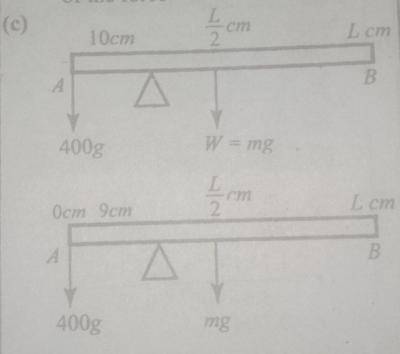
(c) A uniform stick AB of length, L, and mass, m, is balanced horizontally on a knife edge 10.0cm from A when an object of 400 g is suspended at A. When the knife edge is moved 5 cm further, the object has to be moved to a point 9.00 cm from A for the stick to balance.
(i) Represent the balance system with a suitable diagram
(ii) Determine the: I. mass, m of the stick; II. length, L.
(d) Explain in terms of air molecules why pressure at the top of a high mountain is less than at sea level.
(e) Mercury of density 13.6 x 10³kgm−3 is poured in a container of uniform cross-sectional area 40cm 2 to a height of 20 cm. The total pressure exerted on the base of the container is 1.42 x 10⁵P. Calculate the: (i) mass of the mercury in the container and (ii) pressure exerted at the surface of the mercury. [g = 10ms−2.
Answers:
(ai) Increasing the temperature of a liquid decreases the viscosity of the liquid. (aii) Increasing the temperature of a gas increases the viscosity of the gas
(b) Factors that determine the magnitude of the moment of a force about a point are: 1. Angle between the distance from the turning point and the line of action of the force. 2. magnitude of the applied force. 3. perpendicular distance from the pivot to the line of action of the applied force.
(c) SEE THE DIAGRAM ABOVE.
(ii) Taking a moment about the support: clockwise moment = anti-clockwise moment
400 x 10 = m x (L2 – 10) — ——- from figure 1 above
4000 = m x (L2 – 10) – – – — – – (i)
400 x 6 = m x (L2 – 15) – – – – — – – -(ii)
divide eqn i by ii
40002400 = m×L2−10)m×L2−15)
53 = L2−10)L2−15)
3 x (L2 – 10) = 5 x (L2 – 15)
3L2 – 30) = 5L2 – 75)
5L2 – 3L2 = 75 – 30 = 45
L = 2L2 = 45 cm
From equation (ii) 400 x 6 = m x (L2 – 15)
2400 = m x (452 – 15)
2400 = m x 7.5
m = 24007.5 = 320 g
Therefore, I. m = 320g and II. L = 45 cm
(d) Reasons for less pressure at the top of a mountain:
The lower pressure at the top of a mountain is due to the reduced number of air molecules in the atmosphere above that elevation, resulting in a lighter air column and fewer molecular collisions, which together create lower atmospheric pressure compared to sea level.
(e)(i) Density = ρ = mv
m = v x ρ, but v = A x h
m = A x h x ρ = 13.6 x 103 x 40 x 20 x 10−6 = 10.88kg
(e)(ii) pressure exerted by the surface of the mercury
Pt = Patm + pressure of mercury
Patm = Pt – ρ x h x g = 1.42 x 10⁵ – 13.6 x 103 x 0.2 x 10 = 1.148 x 10⁵Pa.
Q3.
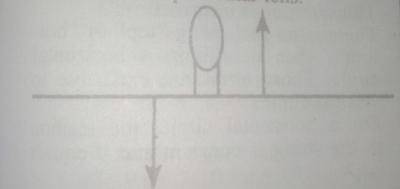
(a) State the condition for light ray incident on a concave mirror to reflect through the principal focus of the mirror.
(b) Explain spherical aberration as a defect of curved mirrors
(c) The diagram above illustrates an image formed when an object is placed in front of a particular lens. Redraw the diagram and indicate the center of curvature, C, principal focus, F, and the principal axis. ( SEE THE DIAGRAM ABOVE)
(d) What is meant by accommodation in connection to the human?
(e) State quantitatively, the (i) values of the near and far point of a normal eye. (ii) Use the answer in 10c(i) to determine the change in optical power of the normal human eye when reading a book and viewing the sky.[lens-to-retina distance = 2.5 cm].
Q4.(a) Mention three facts about photoelectric effect
(b) An electric magnetic radiation source of power 6 x 10⁻³ W emits 1 x 10¹⁶ photons per second. The most energetic photo electron ejected from a metal surface is stopped by a potential difference of 2.2V. Calculate the work function of the metal. [ mass of (photon) electrons 9.1 x 10⁻³¹ kg, e = 1.6 x 10⁻¹⁹ C]
(c) State two factors on which the activity of a radioactive sample depends
(d) Cobalt-60 source has an activity of 2.0 x 10⁶ Bq and a half-life of 1.8 x 10⁸s. Calculate the number of radioisotope nuclei in the source.
Q5.(a)i State the condition for a charged particle to experience a force in magnetic field
(ii) State the expression for the magnetic force, F acting on a charged particle, Q in a magnetic field of flux density, β with speed, V
(iii) Prove quantitatively that there is no magnetic force moving along the direction of a magnetic field.
(b)i Mention the main parts of an electrical transformer.
(ii) Explain how an alternating potential difference applied to the primary coil gives rise to an induced e.m.f in the secondary coil of a transformer.
(c) Proton of mass 1.7 x 10(^{-27}\) kg enters a magnetic field of flux density 0.207 normally and followed a quarter circle path before existing with a constant speed of 4.5 x 10⁶m/s
(i) Explain why the speed of the proton remains constant.
(ii) Calculate the
I. radius of the circular path
II. time taken by the proton to move through the magnetic field [e = 1.6 x 10⁻¹⁹ C, π = 3.14]
How to pass WAEC exams
It’s important to make your West African Senior Secondary School Certificate Examination a huge success. The following ways are beneficial to candidates that wish to pass WAEC with flying colors:
1. Make adequate Preparation: By preparing very well for the WAEC Physics Objectives and theory exams, candidates will be able to write the exams confidently.
2. Attending Extra moral Classes: The school teachers might not be able to complete the curriculum on time. On that note, it is advisable for students to attend tutorials that will enlightened the more on the right topics under The syllables.
3. Make good use of Past Questions: The West African Examination Council, WAEC has a pattern of setting questions. Students that make good use of the WAEC Physics past Questions and Answers will surely perform well in the exams. Try and practice the questions set on previous years.
4. Use WAEC Physics Syllabus: The WAEC Physics Syllabus has a list of topics to be treated for years. Candidates should ensures that they use the syllabus while studying and preparing for their exams.
Steps to Answer Questions
The following steps are crucial while trying to answer WAEC Physics questions:
- Candidates are advised to always begin with the simplest questions.
- Adherence to the WAEC exams instructions are very important.
- All the required details should be carefully written or entered on the WAEC Answer booklet.
- Candidate’s handwriting should be very readable.
- It’s important to attempt the required number of questions.
- Candidates should cross check their answers before final submission.
Conclusion
Passing the WAEC Physics exams is very easy. All that is required is to do the needful. Prepare on time, attend tutorials, use past Questions and syllabus and many more.
Those that want to know more about the WAEC Physics questions and Answers should use the comments box hereunder.
Related Post
- WAEC Agric Science Questions and Answers
- WAEC Mathematics Questions and Answers
- WAEC Timetable
- WAEC Agric Science Questions and Answers
- WAEC Data Processing Questions and Answers
- WAEC Civic Education Questions and Answers
- WAEC Literature in English Questions and Answers
- WAEC Geography Questions and Answers
- WAEC Government Questions and Answers
- WAEC Chemistry Practical Questions and Answers
- WAEC Marketing Questions and Answers
- WAEC Chemistry Questions and Answers
- WAEC Biology Practical Questions and Answers
- WAEC Biology Questions and Answers
- WAEC Economics Questions and Answers

Thanks but can i get the physics essay and answers