
Likely WAEC Biology Practical Specimens free and correct Questions and Answers available online for you. Candidates in need of the Correct Biology 2026 Alternative to WAEC Practical Specimens can now explore download likely Biology Practical Expo Runs today.

You are on the right page. with this opportunity, you should be able to perform well in your WASSCE Biology practical exams. Alternative A & B Practical Questions and Answers for SSCE. Learn more about The SSCE Questions and Answers tips on Alternatives to biology Practical provided below.
The West African Examination Council (WAEC) Biology Practical Specimens paper schedule is available in the official WAEC Timetable. All the necessary materials will be provided by the management board for the smooth running of the exams. To pass WAEC Biology Practical with A1, keep reading fore latest news on correct WAEC Biology Practical Specimens answers.
Introduction to Biology Practical 2026 Questions
The specimens are usually labeled. The labels may range from A to Z. To tackle these questions correctly, kindly read the questions at least 3 times. These really guide you to pass the WAEC 2026 Alternative to Biology Practical Specimens questions very well.
PAPER 3 (PRACTICAL)
The practical paper will take place on the biology laboratory. Make good use of the specimens and the practical apparatus provided.
Always call the attention of the lab attendant where there’s need for questions and guidance.
WAEC Practical Biology Specimens
The Following are Past Specimens Use for WAEC Biology Exams:
SECTION A
Q1.Study specimens F, H and K and answer questions 2(a) to 2(d).
(a) State four functions of specimen H to the plant from which it was obtained.
b(i) State one function each of specimen F and K to the plants from which they were obtained.
F:
K:
(ii) Give one reason for the answers in 2b(i)
F:
K:
(iii) What part of the plant is modified for the function stated in 2b(i)?
F:
K:
c(i) State four observable differences between specimens F and K.
| F | K |
(ii) State one similarity between specimens F and K.
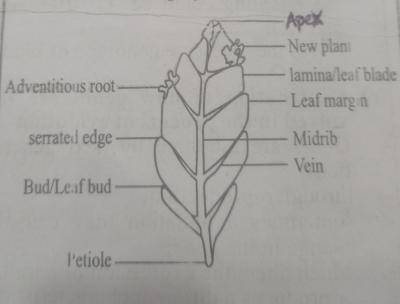
(d) Make a drawing; 6 cm to 8 cm long of the specimen H and label fully.
Answers:
Specimen F – Ginger rhizome
Specimen H – Leaf of Boplytum
Specimen K – Cassava tuber
(a) Functions of specimen H to the plant from which it was obtained.
– site for photosynthesis
– for exchange of gases
– for transpiration
– asexual reproduction
– water storage
b(i) one function each of specimen F and K to the plants from which they were obtained.
F: stores food, helps the plant reproduce and survive unfavorable seasons.
K: storage of food
(ii) one reason each for the answers in 2b(i)
F: presence of buds / rhizome located underground
K: presence of swollen root
(iii) Part of the plant modified for the function stated in 2b(i)?
F: stem
K: root
c(i)Four observable differences between specimens F and K.
| F(Ginger rhizome) | K(Cassava) |
| presence of buds | absence of buds |
| presence of nodes and internodes | Absence of nodes and internodes |
| presence of adventitious roots | presence of lateral roots |
| smaller in size | Bigger in size |
(ii) Similarity between specimens F and K.
– both are modified underground stems.
– both storage organs.
– both swollen
– both are carbohydrates
(d) Labelled diagram of Specimen H (see diagram above)
Q2.Study specimens B, D and E and answer questions 1(a) to 1(f).
(a) Name the phylum and class of the organism that possesses specimen D.
Phylum:
Class:
(b) State three observable features of Specimen B.
c(i) Give three functions of specimen B to the organism from which it was obtained
(ii) State one function each of specimens D and E to the organism from which they were obtained.
D:
E:
(iii) Mention one adaptation each of specimens D and E to the function stated in 1c(ii)
D:
E:
d(i) Use the office pin provided to prick the dark green structure attached to specimen B. Touch the fluid oozing from the structure with each of the red and blue litmus
papers at intervals. Record the observations and inferences on the table below:
| Test | Observation | Inferences |
| Red litmus paper + fluid | ||
| Blue litmus paper + fluid |
(ii) Give three functions of the fluid tested in 1d(i) to the organism that possesses it.
e(i) Name the biological system in the body of vertebrates that specimens D and E belongs to.
(ii) Which of specimens B, D or E is absent in humans?
f(i) Name the mode of feeding of the organism that possesses specimen E.
(ii) Name one type of food that the organism that possesses specimen D consumes.
Answers:
Specimen B – whole liver from a domestic fowl
Specimen D – gizzard
Specimen E – Intestine
(a) Phylum: Chordata / Vertebrata
Class: Aves
(b) Observable features of specimen B
– reddish/dark red colour
– has a greenish sac attached to it (presence of gall bladder)
– cone shaped
– soft and spongy to touch
c(i) Functions of specimen B to the organism from which it was obtained
– regulation of blood sugar level
– deamination of proteins/excretion of nitrogenous waste
– formation of fibrinogen
– produce heat for maintaining constant body temperature
– stores Vitamin A, B, D and E.
(ii) one function each of specimens D and E to the organism from which they were obtained.
Specimen D – help domestic fowl break down food into smaller, more digestible pieces.
Specimen E – digest food and absorb nutrients from it.
(iii) one adaptation each of specimens D and E to the function stated in 1c(ii)
D: a thick muscular wall, a hardened cuticle, and sometimes small stones called gastroliths.
E: have a short, efficient digestive system that’s adapted for fast digestion.
(d)(i)
| Test | Observation | Inferences |
| Red litmus paper + fluid | fluid turns litmus paper blue | Basic or alkaline |
| Blue litmus paper + fluid | Blue litmus paper remains unchanged | Not acidic but basic or alkaline |
(ii) Functions of Bile
– breaks down fat globules into smaller pieces so they can be digested
– helps the body absorb fat, cholesterol, and fat-soluble vitamins
– neutralizes the acidic chyme from the stomach
– carries bilirubin, a waste product from red blood cells, out of the body in faeces
– carries excess cholesterol out of the body
– has antibacterial properties that help fight microorganisms in food.
e(i) The biological system in the body of vertebrates that specimens D and E belongs to is the Digestive system.
(ii) Specimen D (gizzard) is absent in human
f(i) The mode of feeding of the organism that possesses specimen E(intestine) is heterotrophic/ holozoic mode of nutrition.
(ii) The type of food that the organism that possesses specimen D consumes.
– grains
– seeds
– crops
– insects
SECTION B
Answer all the questions in this section
Q3. Study specimens L, M, P, and Q and answer questions 3(a) to 3(d).
(a) Name the region of the human body where each of specimens L and Q are located.
L:
Q:
b(i) State four observable differences between specimens L and Q.
| L | Q |
(ii) State four observable similarities between specimens L and Q.
c(i) Name two bones each that articulate with specimens M and P.
(ii) Name one vertebra each that is located and after each of specimens L and Q in the vertebral column.
Before After
L: …………………………… ………………………………
Q: ………………………….. ……………………………….
(d) Complete the table below by using tick (✔) to indicate presence and cross (X) to indicate absence of the following features in each of specimens L, M, P and Q.
| Specimen | Features | |||
| Neural canal | Rounded head | Neural spine | Long shaft | |
| L | ||||
| M | X | |||
| P | ||||
| Q | ✔ | |||
Answers:
Specimen L – Thoracic vertebra
Specimen M – Humerus bone
Specimen P – Femur bone
Specimen Q – Lumbar Vertebra
(a) Region of the human body where each of specimens L and Q are located.
L: chest or thorax region
Q: abdominal region or between thoracic and sacral vertebrae
b(i)Four observable differences between specimens L and Q.
| L(Thoracic vertebra) | Q(Lumbar vertebra) |
| presence of small centrum | presence of large centrum |
| Neural spine is long | Neural spine is short |
| Transverse process is long | Transverse process is short |
| Absence of anapophysis | Anapophysis is present |
| Demifacets are present | Demifacets are absent |
(ii) Observable similarities between specimens L and Q.
– Both thoracic and lumbar vertebrae have facet joints that articulate with adjacent vertebrae.
– Both thoracic and lumbar vertebrae have a body.
– Both thoracic and lumbar vertebrae have a spinous process that extends backward.
– Both thoracic and lumbar vertebrae have transverse processes that extend laterally.
– Both of them possess neural arch.
c(i) Bones each that articulate with specimens M(humerus bone) and P(femur bone)
M: scapula, ulna, cervical
P: pelvic girdle, tibia
(ii) One vertebra each that is located and after each of specimens L and Q in the vertebral column.
Before After
L: …cervical vertebra.. …Lumbar vertebra…
Q: ….thoracic vertebra.. ….sacral vertebra….
(d)
| Specimen | Features | |||
| Neural canal | Rounded head | Neural spine | Long shaft | |
| L(thoracic) | ✔ | X | ✔ | |
| M(humerus bone) | X | ✔ | X |
✔ |
| P(femur bone) | ✔ | X |
✔ |
|
| Q(Lumbar vertebra) | ✔ | X | ✔ | |
Practical Expo/Runs 2026
It’s important to know that infoshoutloud.com.ng team do not supply WAEC Expo or Runs. Beware of some fraudulent platforms promising you Expo on WAEC Practical, stay guided.
All we do is to ensure that we provide you with all the necessary steps and updates on how to pass your exams without Stress. Stay tuned for more latest Related Updates today.
How to Answer WAEC Questions
The following steps are very important for candidates that wish to make good grades:
1. Read all the Instructions provided in the Question paper: This is a very important thing to do as soon as the Question paper is given to you. The essence of this is to help you know what you are required to do. Try as much as possible to adhere to the exams instructions.
2. Fill in Your details where required on the Answer booklets. One of the greatest mistakes candidates make is failure to write their details on the Answers booklet. Filling Your exams details before attempting questions is important because you may forget or may cut off with time.
3. Start with the Questions you know best: This is a smart approach. When you start answering the questions you know very well, you will not only have the confidence to answer the difficult ones but give the marker/examiner a good impression about your knowledge of the subject.
4. Read the Questions at least Thrice before providing solutions: Don not be in a haste to answer questions. Try and read them over and over again to gain full understanding of the questions.
5. Make your handwriting are readable: Take your time to write very well, a good handwriting will make your answers clear understandable.
6. Cross Check your work before submission: I’m all your doing, don’t fail go through your work before submitting your answer booklet. This will enable you to correct mistakes made.
The following are very useful in planning to make WAEC huge success:
- Make adequate Preparation for the Biology Practical Exams
- Use Biology Practical Manual and Recommended textbooks
- Have self-confidence
- Pray to God your Creator concerning your exams
- Be at the Biology Practical exams venue early
- Follow strictly the instructions on the exam paper
- Make good Use of WAEC syllabus
I hope the “Correct WAEC Biology Practical Questions and Answers” article was very useful to you. Please kindly share it with friends. The comment box is there for you, leave you suggestions there.
Related Post
- WAEC Mathematics Questions and Answers
- WAEC Data Processing Questions and Answers
- WAEC English Language Questions and Answers
- WAEC Biology Practical Specimens Questions and Answers
- WAEC Computer Studies Questions and Answers
- WAEC Civic Education Questions and Answers
- WAEC Literature in English Questions and Answers
- WAEC Biology Questions and Answers
- WAEC Physics Practical Questions and Answers
- WAEC CRK/CRS Questions and Answers
- WAEC Geography Questions and Answers
- WAEC Chemistry Questions and Answers

I don’t understand
Check back
I don’t understand
Check back for updates, you will understand
This is absolutely good God bless nigeria
This is alright thanks
Pls I need waec biology practical for 17th of September 2021 before the exam commence pls
Pls send some biology practical before tomorrow
Please biology practical answers
I need the biology answer am in need of it
Biology mock practical ss3 2023
Please send some biology mock practical exam this night
Biology practical for exam 2023 pls
Biology practical for exam 2023 please
Please send me biology practical exam this night or tomorrow morning please.
Biology theory and objective please I need it
I need biology practical theory and objective please help me
I need biology practical theory and objective please
I need biology practical
I wamt waec answers for math,English,Economics,government,biology,agric,marketing.
physics practical