
Likely WAEC Physics free and correct Practical Questions and Answers is now online for all candidates. People may wish to have access to WAEC expo/runs in Physics Practical, but I tell you, the details on Practical Physics WAEC Questions and Answers provided for you here is the best.

It’s obvious many might be searching for 2026 free West African Examination Council (WAEC) Physics Practical expo or runs. Explore all the necessary updates on the Physics Practical exams and PDF download hereunder.
In addition, there is sampled WAEC Physics Practical Past Questions and Answers for practice before the main exams. Do well to make good use of the likely WAEC expo/runz Alternative to Physics Practical updates provided hereunder.
Practical Physics Answers to Questions
The Following are Past Questions on Physics Practical:
Q1.
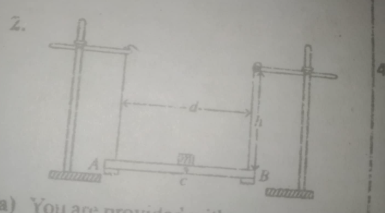
(a) You are provided with two metre rules, two retort stands, a mass, m = 100g, thread, and other necessary apparatus
(i) Place one of the metre rules on a knife edge and determine the centre of gravity, C
(ii) Measure and record the mass, MR of the metre rule
(iii) Attach the mass = 100g firmly to the metre rule AB at C using paper tape
(iv) Suspend the metre rule by two parallel threads of length, h = 40cm each at 10 cm and 90cm mark. Ensure that the graduated face of the metre rule is facing upwards.
(v) Set the metre rule into small angular oscillation about the vertical axis through the centre of gravity.
(vi) Determine the time, t for 20 complete oscillations. Evaluate the period T and T2.
(vii) Read and record the value of d in metres.
(viii) Keeping d, constant, repeat the procedure for four other values of h = 50, 60, 70, and 80 cm. In each case, determine t and evaluate T and T2.
(ix) Tabulate the readings
(x) Plot a graph of T2 on the vertical axis and h on the horizontal.
(xi) Determine the slope, s of the graph
(xii) Evaluate K = S/Q where Q = 2/25d2
(xiii) State two precautions taken to ensure accurate results
b(i) Define couple as it relates to oscillatory motion
(ii) Give two practical applications of a couple in everyday life.
Answer:
(a)i c = 50.0cm
(ii) MR = 90.0 g
(vii) d = 0.8m
(ix)
| S/N | h(cm) | t(s) | T= t20s | T2s2 |
| 1 | 40.0 | 26.12 | 1.306 | 1.7056 |
| 2 | 50.0 | 27.80 | 1.390 | 1.9321 |
| 3 | 60.0 | 30.68 | 1.534 | 2.3532 |
| 4 | 70.0 | 34.60 | 1.730 | 2.9929 |
| 5 | 80.0 | 35.80 | 1.790 | 3.2041 |
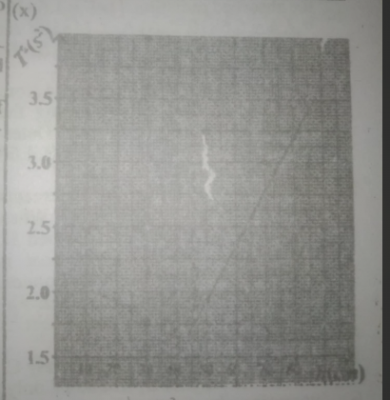
(x) SEE THE GRAPH ABOVE
(xi) Slope, s = ΔT2/Δh = (3.0−1.75)/(75−46) = 1.25/29 = 0.431s2cm−1
(xii) K = S/Q
where, Q = 2/25d2 = 2/25×(0.8)2 = 0.125
K = S/Q = 0.431/0.125 = 0.3448
b(i) A couple, as related to oscillatory motion, refers to a pair of forces that are equal in magnitude but opposite in direction, and act on opposite sides of a pivot or fulcrum, causing rotation or torsion.
b(ii) I. Wrenches: When using a wrench to tighten or loosen a bolt, the force applied creates a couple that produces rotational motion. ]
II. Steering Wheels: Turning the steering wheel of a car applies a couple that rotates the front wheels, allowing for directional change.
III. Door Handles: When pushing or pulling on one side of a door handle, a couple is created that rotates the door about its hinges.
IV. Bicycle Pedals: When pedaling a bicycle, the force applied to the pedals generates a couple that turns the crankshaft, propelling the bike forward.
Q2.

ALTERNATIVE B
(a) You are provided with a variable DC power supply E, a key, an ammeter, a voltmeter and other necessary materials
(i) Set up a circuit as shown in the diagram above with E = 3.0V
(ii) Close the key.
(iii) Record the voltmeter reading, V
(iv) Read the corresponding ammeter reading, I
(v) Evaluate V−1 and I−1
(vi) Repeat the procedure for the four other values of E = 4.5V, 6.0V, 7.5V and 9.0V.
(vii) Tabulate your readings.
(viii) Plot a graph with I−1 on the vertical axis and V−1 on the horizontal axis starting with both axes from the origin. (0, 0)
(ix) Determine the slope, s of the graph.
(x) Also, determine the intercept, c on the vertical axis
(xi) What does the slope, s represent?
(xii) State two precautions taken to ensure accurate results.
(b) State two methods by which an electric current can be produced
(i) State Ohm’s law.
Answer:
(vii)
| E(V) | V(V) | I(A) | V−1(V−1) | I−1(I−1) |
| 3.00 | 2.86 | 1.43 | 0.350 | 0.699 |
| 4.50 | 4.28 | 2.14 | 0.234 | 0.467 |
| 6.00 | 5.70 | 2.86 | 0.175 | 0.350 |
| 7.50 | 7.14 | 3.57 | 0.140 | 0.280 |
| 9.00 | 8.57 | 4.28 | 0.117 | 0.234 |
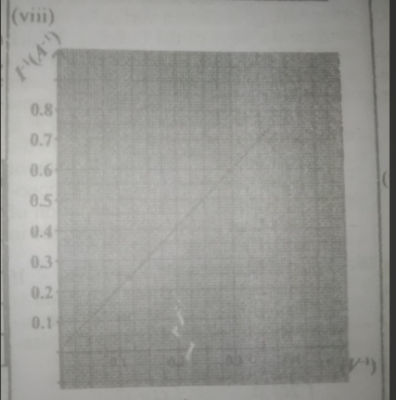
(viii) SEE THE GRAPH ABOVE
(ix) Slope = ΔI−1/ΔV−1 = 0.6−0.3/0.3−0.15 = 0.3/0.15 = 2
(x) Intercept, c = 0.01
(xi) Slope, s represents external resistance of the circuit
(xii) I. I ensured tight connections II. I avoided error due to parallax on the ammeter/voltmeter
b(i) I. Use of cell II. hydropower
(ii) Ohm’s law states that the current passing through a metallic conductor is directly proportional to the potential difference applied at both ends provided temperature remains constant.
Q3.
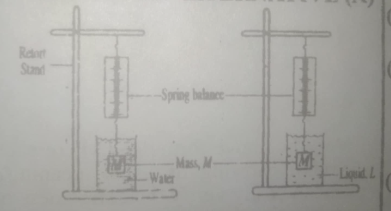
(a) You are provided a retort stand, a spring balance, masses, a beaker containing water, another beaker containing a liquid labelled, L, and other necessary apparatus.
(i) Suspend the mass, m = 20 g on the spring balance and measure the weight in air, WA in Newton.
(ii) Immerse the suspended mass completely in water and measure weight in water, WW in Newton. Evaluate U1 = WA – WW.
(iii) Immerse the suspended mass completely in the liquid L of the same volume with water and measure the weight in liquid WL. Evaluate U2 = WA – WL.
(iv) Repeat the procedure for m = 40g, 60g, 80g, and 100g respectively. In each case, evaluate WA, WW, U1, WL, U2.
(v) Tabulate the readings.
(vi) Plot a graph of U1 on the vertical axis and U2 on the horizontal axis starting both axes from the origin (0, 0).
(vii) Determine the slope s of the graph
(viii) Evaluate K = 1s
(ix) State two precautions taken to ensure accurate results.
b(i) State the Archimedes’ principle,
(ii) State two differences between density and relative density
Answer:
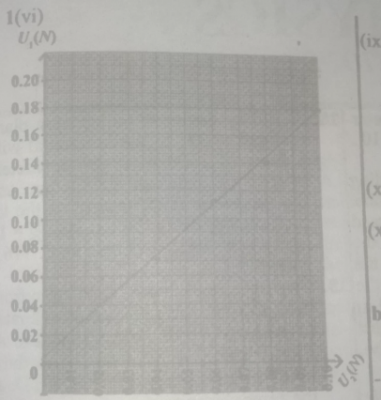
(v)
| M(g) | WA(N) | WW(N) | U1 = WA – WW. | WL(N) | U2 = WA – WL |
| 20.0 | 0.20 | 0.16 | 0.04 | 0.18 | 0.02 |
| 40.0 | 0.40 | 0.33 | 0.07 | 0.36 | 0.04 |
| 60.0 | 0.60 | 0.49 | 0.11 | 0.54 | 0.06 |
| 80.0 | 0.80 | 0.66 | 0.14 | 0.72 | 0.08 |
| 100.0 | 1.00 | 0.82 | 0.18 | 0.90 | 0.10 |
(vi) SEE THE GRAPH ABOVE
(vii) s = ΔU1/ΔU1 = 0.162−0.2/0.09−0.067 = 0.042/0.023 = 1.826
(viii) K = 1/s = 1/1.826 = 0.5476
(ix)(I) I avoided errors due to parallax when reading the spring balance. (II) I cleared the mass thoroughly before immersing it in liquid L
b(i) Archimedes’s principle states that when a body is completely or partially immersed in a fluid, it experiences an upthrust which is equal to the weight of fluid displaced.
(ii) Density has a unit whereas relative density has none. (II) The value of density is different in different systems of measurement, whereas relative density is the same in all systems of measurement.
Q4.
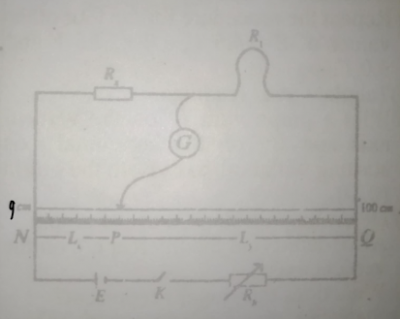
(a) You are provided with two resistance wires labelled: A and B, standard resistor, Rx = 1 Ω, metre bridge, cell of emf,E, Rheostat Rh, galvanometer and apparatus as shown.
Use the circuit diagram above as a guide to perform the experiment.
(i) Connect Rx in the left-hand gap of the metre bridge, a length L = 100 cm of the wire in the right-hand gap and the other apparatus shown.
(ii) Determine and record the balance point P on the metre bridge wire NQ
(iii) Measure and record Lx = NP and Ly = PQ
(iv) Evaluate R1 = Ly/Lx(Rx)
(v) Repeat the procedure for four other values of L = 90cm, 80cm, 70cm, and 60cm. In each case, determine and record the balance point, P and evaluate R1
(vi) Repeat the experiment with the second wire B. Obtain the balance point P and evaluate R2 in each case
(vii) Tabulate the readings
(viii) Plot a graph of R2 on the vertical axis and R1 on the horizontal axis
(ix) Determine the slope, s, of the graph
(x) Evaluate K = s√
(xi) State two precautions taken to ensure accurate results.
b(i) State two advantages of potentiometer over voltmeter for measuring potential difference
(ii) Define internal resistance of a cell.
Answers:
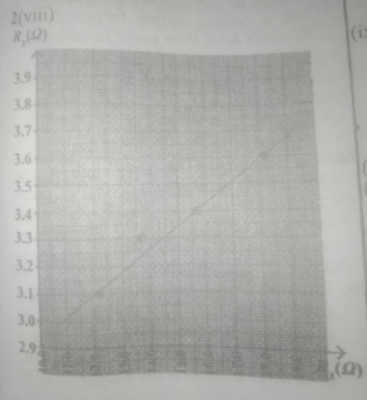
(vii)
| L(cm) | Lx(cm) | Ly(cm) | R1 = (LyLx)RxΩ | Lx2 | Ly2 | R2 = Ly2Lx2RxΩ |
| 100.0 | 5.2 | 94.8 | 18.2 | 21.5 | 78.5 | 3.6 |
| 90.0 | 6.0 | 94.0 | 15.7 | 22.5 | 77.5 | 3.4 |
| 80.0 | 6.8 | 93.2 | 13.7 | 23.4 | 76.6 | 3.3 |
| 70.0 | 7.6 | 92.4 | 12.2 | 24.5 | 75.5 | 3.1 |
| 60.0 | 8.4 | 91.6 | 10.9 | 25.6 | 74.4 | 2.9 |
(viii) SEE THE GRAPH ABOVE
(ix) Slope = ΔR2/ΔR1 = 3.5−3.3/17.0−14.6 = 0.22.4 = 0.083
(x) K = 0.083−−−−√ = 0.2881
(xi) I Tight connection/clean terminal was ensured II. Key removed when readings were not being taken.
b(i) I. A potentiometer can be used for measuring the internal resistance of a cell and also to compare the e.m.f. of two cells. II. A potentiometer gives the exact value of potential difference across any two points in a circuit.
(ii) It refers to the opposition to the flow of current offered by the cells and batteries themselves resulting in the generation of heat.
How to pass WAEC exams
It’s important to make your West African Senior Secondary School Certificate Examination a huge success. The following ways are beneficial to candidates that wish to pass WAEC with flying colors:
1. Make adequate Preparation: By preparing very well for the WAEC Physics Practical exams, candidates will be able to write the exams confidently.
2. Attending Extra moral Classes: The school teachers might not be able to complete the curriculum on time. On that note, it is advisable for students to attend tutorials that will enlighten the more on the right topics under the syllables.
3. Make good use of Past Questions: The West African Examination Council, WAEC has a pattern of setting questions. Students that make good use of the WAEC Physics Practical past Questions and Answers will surely perform well in the exams. Try and practice the questions set on previous years.
4. Use WAEC Physics Practical Syllabus: The WAEC Physics Practical Syllabus has a list of topics to be treated for years. Candidates should ensures that they use the syllabus while studying and preparing for their exams.
How to Answer Practical Physics Questions
The following steps are very important for candidates that wish to make good grades:
1. Read all the Instructions provided in the Question paper: This is a very important thing to do as soon as the Question paper is given to you. The essence of this is to help you know what you are required to do. Try as much as possible to adhere to the exams instructions.
2. Fill in Your details where required on the Answer booklets. One of the greatest mistakes candidates make is failure to write their details on the Answers booklet. Filling Your exams details before attempting questions is important because you may forget or may cut off with time.
3. Start with the Questions you know best: This is a smart approach. When you start answering the questions you know very well, you will not only have the confidence to answer the difficult ones but give the marker/examiner a good impression about your knowledge of the subject.
4. Read the Questions at least Thrice before providing solutions: Don not be in a haste to answer questions. Try and read them over and over again to gain full understanding of the questions.
5. Make your handwriting are readable: Take your time to write very well, a good handwriting will make your answers clear understandable.
6. Cross Check your work before submission: I’m all your doing, don’t fail go through your work before submitting your answer booklet. This will enable you to correct mistakes made.
Practical Specimens WAEC Expo/Runs
It’s important to let you know that infoshoutloud.com.ng team do not supply WAEC Expo or Runs. Beware of platforms promising you Expo on WAEC Physics Practical.
All we do is to ensure that we provide you with all the necessary steps and updates on how to pass your exams without Stress. Stay tuned for more Related Updates.
If your still have something to ask about the WAEC Questions and Answers for Physics Practical, use the comments section below.
Related Post
- WAEC Biology Questions and Answers
- WAEC Government Questions and Answers
- WAEC Chemistry Questions and Answers
- WAEC Economics Questions and Answers
- WAEC Literature in English Questions and Answers
- WAEC Geography Questions and Answers
- WAEC Physics Practical Questions and Answers
- WAEC Agric Science Questions and Answers
- WAEC Mathematics Questions and Answers
- WAEC Computer Studies Questions and Answers
